

“Critically reflective practice is a process of inquiry involving practitioners in trying to discover, and research, the assumptions that frame how they work (Brookfield, 1998).

Teaching is a life-long learning experience. It is important to continuously reflect on the way we teach and deliver course material. To be excellent teacher, we need to incorporate critical reflection to make sure that we are achieving our teaching goals, as well as it motivates your students to become critically reflective students.
To incorporate trauma-informed practice and patient-centered care into pharmacy practice, critical reflection is needed in order to see how power and hegemony has impacted the education and healthcare system, as well as how are beliefs, values, and assumptions can impact the care we provide to students, as well as how my teaching may affect my students. “Reviewing practice… makes us more aware of those submerged and unacknowledged power dynamics that infuse all practice settings” (Brookfield, 1998).
Brookfield proposes four lenses that instructors can engage in as part of their critical reflective practice.
Lens One: Autobiographical or Self-Reflection Lens: in this lens we examine how our own personal learning experience impacts our teaching practice or teaching style. This may reveal areas of our pedagogy that need to be adjusted or strengthened. “When we are trying to uncover our most deeply embedded allegiances and motivations as teachers, a useful path analysis is to study our autobiographies as learners” (Brookfield, 1998).
Lens Two: Our Learners’ Lenses
Utilizing student feedback, we can reflect on our teaching practice through the eyes of our students. This allows us as instructors to teach more responsively, and make any adjustments to our pedagogy to support student equity or provide greater impact. “The most fundamental metacriterion for judging whether or not good educational practice is happening is the extent to which educators deliberately and systematically try to get inside learners’ heads and see classrooms and learning from their point of view” (Brookfield, 1998).
Lens Three: Our Colleagues’ Lens
Our peers can highlight habits in our teaching practice that we may not be aware of, mentor us, and provide advice and feedback that we can utilize in our teaching practice. “We need colleagues to help us know what our assumptions are and to help us change the structures of power so that democratic actions and values are rewarded within, and without, our institutions” (Brookfield, 1998).
Lens Four: Theoretical Literature
Literature can help us find a name for our type of teaching practice, find multiple perspectives to situations, and help us realize that when we believe we are failing as teacher, there are other factors, such as economic, social, and political processes, that may be affecting how we are able to teach. “Teachers who research, present, or publish scholarly literature display an advance vocabulary for teaching practice, which can become a “psychological and political survival necessity, through which teachers come to understand the link between their private (teaching) struggles and broader political processes… scholarly literature supports teachers and also clarifies the contexts in which they teach” (Miller, 2010).
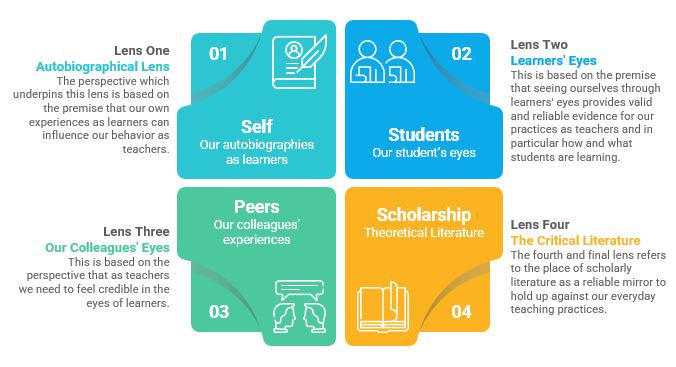
Image by Slide Salad. Retrieved November 24, 2024, from https://jcu.pressbooks.pub/tcaue/chapter/dimensions-of-learning/
For additional information, read
Critical Reflection in Pharmacy Practice
“An engaged pharmacy professional is one who embraces the full scope of their practice and, through the establishment of meaningful, professional relationships with their patients and colleagues, demonstrates the tenets of professionalism. These tenets include taking a person-centred approach to their professional service, using good judgement, collaborating, leading, having a strong set of values, and being an active learner” (Alberta College of Pharmacy, 2020)
Continuous education and active learning is necessary as regulated health professionals. It is important that pharmacy technicians and pharmacists critically reflect in order to identify knowledge gaps and keep up-to-date with new and current pharmacy practices. The field of pharmacy and scope of practice for pharmacy technicians is continuously evolving, therefore in after formal schooling we are continuously learning.
Critical reflection in pharmacy practice requires pharmacy technicians to assess the following when seeking out learning opportunities related to our practice:
- Why do I want to do this?
- How does it fit within my scope of practice?
- How does it fit within… Code of Ethics and the Standards of Practice for Pharmacists and Pharmacy Technicians? How does it contribute to person-centred care?
Critical reflection is also important when we are reflecting on our current experience, especially when there have been undesirable situations that have occurred in work day. This allows us to see how our interactions with patients, colleagues, and other healthcare providers may require changes in order to provide safe, reliable, and effective care.
“Reflection enables you to gain insight for meaningful change and development and improve the way you work. It is a valuable skill to help you develop experience, confidence and self-awareness and enables you to invest in yourself and your development in a structured and constructive way” (Pharmacy Council NZ, 2021).
Watch the following video regarding reflective practice in healthcare.
Critical reflection is an ongoing process that needs to be incorporated into teaching and pharmacy practice. It allows us to understand what works and needs to be adjusted in both our teaching and pharmacy practice.
Critically Reflective Practice in Education and Pharmacy © 2024 by Kathleen Young is licensed under CC BY 4.0
References:
Alberta College of Pharmacy. (2020, July 22). Critical Reflective Practice. Retrieve November 24, 2024, from https://abpharmacy.ca/news/critical-reflective-pathway/
Brookfield, S. (1998). Critically Reflective Practice. Journal of Continuing Education in the Health Professions, 18 (4), 197-205. https://doi.org/10.1002/chp.1340180402
Miller, B. (2010). Brookfield’s Four Lenses: Becoming a Critically Reflective Teacher. The University of Sydney.
Subscribe
Enter your email below to receive updates.
 thepharmtechinstructor.blog
Leave a comment