

The Importance of Critical Reflection in Students’ Experiential Learning
As educators, it is very important that our students not just reflect on their experiential learning, but critically reflect in order to connect learning to their experience(s).
The Association for Experiential Education defines experiential learning (education) as “a philosophy that informs many methodologies in which educators purposefully engage with learners in direct experience and focused reflection in order to increase knowledge, develop skills, clarify values, and develop people’s capacity to contribute to their communities” (Experiential Learning Hub, Queens University, 2024). Experiential learning activities include practicum, internships, field trips, etc.
What Exactly Is Critical Reflection?
According to Mezirow (as cited in Kenny, 2010), “critical reflection occurs when we analyze and challenge the validity of our presuppositions and assess the appropriateness of our knowledge, understanding and beliefs given our present contexts.”
To connect learning to experience, students nee to analyze how their emotional response to the experience correlates to the learning objectives of the course.
There are three phases of critical reflection according to Brookfield (as cited in Kenny, 2010):
- “Identifying the assumptions… that underlie our thoughts and actions;
- Addressing and scrutinizing the validity of these assumptions in terms of how they relate to ‘real-life’ experiences and our present context(s);
- Transforming these assumptions to become more inclusive and integrative, and using this newly-formed knowledge to more appropriately inform our future actions and practices.
How Do We Engage Students in Critical Reflection?
As instructors, we can engage students in critical reflective by utilizing different types of reflection, such as cognitive reflection, affective reflection, and process reflection.
The Experiential Learning Office at Ryerson University defines:
- cognitive reflection: examining “the new knowledge and skills the students gain from their experiential learning (2009)”;
- affective reflection: looking “at what students feel as a result of their experience (2009)”;
- process reflection: considering “what students learn from the process itself (2009).”
The article CRITICAL REFLECTION – an integral component to experiential learning, provides sample questions for each of the three types of reflection above that instructors can utilize for student critical reflection.
As an instructor, you may want to utilize the tool below for student critical reflection based on Kolb’s critical reflection cycle (1984):
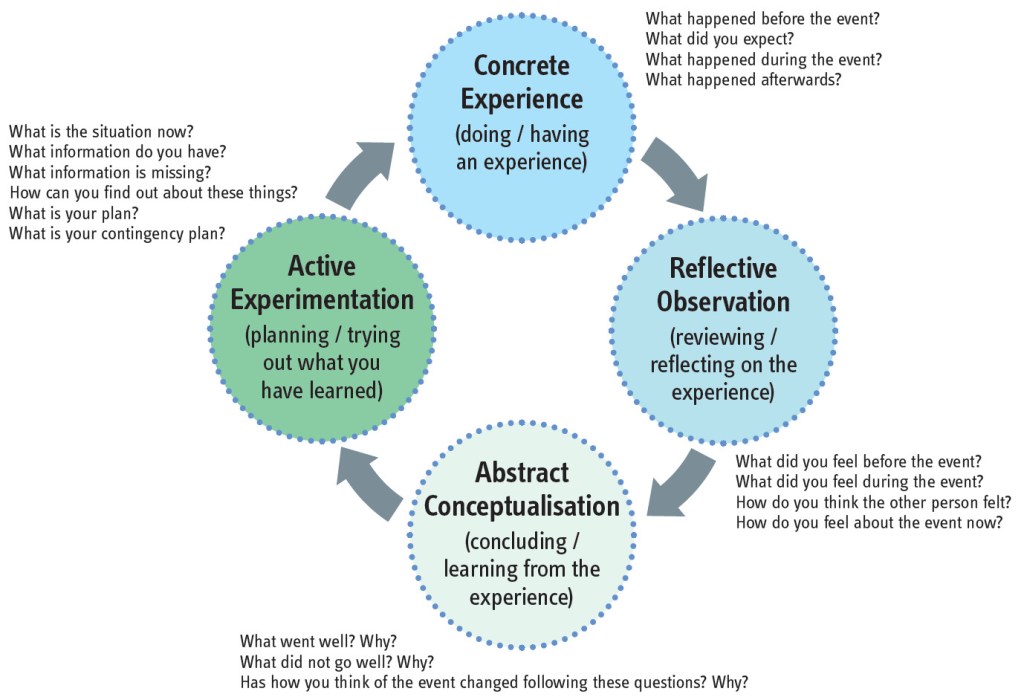
This tool provides example questions which can be asked in supervision to explore all four stages of Kolb’s (1984) critical reflection cycle to solve a dilemma (Research in Practice for Adults, 2016).
Instructors can have students critically reflect prior to, during, and/or after an experiential activity.
Examples of activities that promote critical reflection include journaling, role-playing, discussions, presentations, and written/oral reports.
Summary
By incorporating critical reflection into experiential learning, students will connect their experience to their learning and increase their knowledge. This allows students to transform their learning.
Critical Reflection in Higher Education © 2024 by Kathleen Young is licensed under CC BY 4.0
References:
Experiential Learning Hub. (2024). What is Experiential Learning? Queen’s University. https://www.queensu.ca/experientiallearninghub/about/what-experiential-learning
Experiential Learning Office. (2009). CRITICAL REFLECTION -an integral component to experiential learning. Ryerson University. https://www.mcgill.ca/eln/files/eln/doc_ryerson_criticalreflection.pdf
Kenny, N. (2010). What is Critical Reflection? Centre for Open Learning and Educational Support, University of Calgary. https://natashakenny.ca/wp-content/uploads/2017/05/coles-critical-reflection-handout.pdf
Research in Practice for Adults. (2016). Social Work Practice with Carers. Department of Health. https://carers.ripfa.org.uk/train-the-trainer/critical-reflection-tool/
 thepharmtechinstructor.blog
Leave a comment